

Colony management in Pax Autocratica is the preparation layer for everything that happens beyond the walls. The current Early Access record names a totalitarian colony, citizen conscription, resource gathering, trade with wandering merchants and a work system that spans mining, gathering, hauling, research, manufacturing and farming. Those details describe a connected operating rhythm without requiring a fabricated spreadsheet of yields or a hidden citizen formula.
Read this page from the work ledger outward. First identify the kind of output a job creates. Then connect that output to the next expedition, the troop pool and the battlefield. The result is a practical colony brief: citizens are assigned to a documented role, the role feeds a documented output, and that output supports the state loop. Social relationships sit across the same structure, shaping how the colony feels and how the player interprets a directive.
The page is current-build reference material. Historical prologue context and future-facing plans stay on the updates and state-overview routes so a player can tell which part of the colony picture is being described.
DIRECTIVE 01 / SETTLEMENT MANDATE
A colony built to feed an expedition
The settlement begins as a political project. The documented player action is to establish a totalitarian colony, which gives the colony page a different emphasis from a neutral city builder reference. The important question is not only how to place a building; it is how the state turns citizens, production and policy into enough capacity to send people out again. The colony is a command surface that reaches into the expedition and returns with new pressure.
The current record links expeditions with resource gathering, citizen conscription and trade with wandering merchants. That makes the boundary of the colony deliberately porous. Resources can be acquired outside the settlement, personnel can be drawn into the state, and merchants provide a trading relationship that is distinct from ordinary production. None of those facts requires a numeric exchange rate to be useful. They define the kinds of decisions the player is being asked to make and the systems that should be read together.
A useful mental model is a three-part directive. The first part is supply: create or acquire the inputs the state needs. The second is assignment: put citizens into roles that move those inputs toward a usable form. The third is deployment: decide how the resulting people and equipment enter the next conflict. A strong colony page must preserve all three because a list of jobs without the battlefield handoff would describe only half of the game loop.

LEDGER 02 / WORK RECORDS
Work records and their documented outputs
The work ledger below uses the captured role and output records as its source of truth. Mining and gathering are resource work, but their outputs are described differently: mining produces raw resources, while gathering produces colony inputs. Hauling belongs to logistics and produces centralized supplies. Research belongs to progression and produces technology and options. Manufacturing and farming cover production, with weapons and armor on one side and food on the other.
That vocabulary is enough to make a planning pass without pretending to know a hidden efficiency curve. If a player is preparing an expedition, the question is which output the next state action consumes. If a player is stabilizing the settlement, the question is which role moves a scattered input toward a central supply or a technology option. The table preserves the distinction between role, work type and output so the player can make that comparison directly.
The ledger also explains why the page avoids a universal build order. The source records establish what the roles do, not a fixed schedule that works for every battlefield or citizen mix. Use the output column as a handoff to the next page of the loop, then read combat and updates for the current context around that handoff.
mining
Documented output
raw resourcesgathering
Documented output
colony inputshauling
Documented output
centralized suppliesresearch
Documented output
technology and optionsmanufacturing weapons and armor; farming food
Documented output
equipment and foodDIRECTIVE 03 / CIVIC NETWORK
Citizens, fear and loyalty
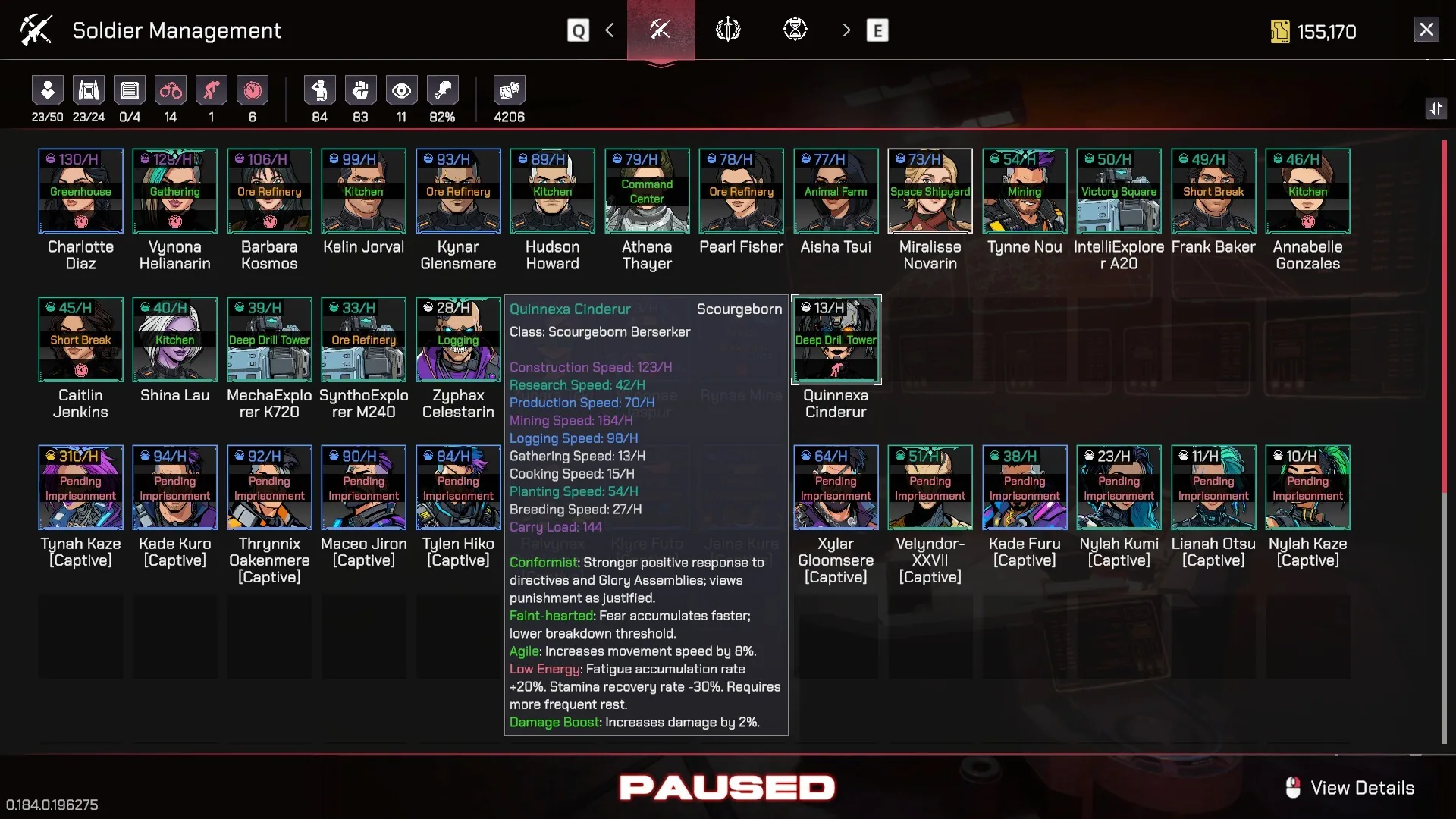
Citizens are not presented as interchangeable labor tokens. The research boundary names fear, loyalty and gratitude as governance pressures and records bonds and feuds between citizens. It also records conscription as part of the expedition loop. Together those facts give the colony a social network: a person can occupy a role, belong to a troop pool and sit inside relationships that affect how a policy is experienced.
The practical consequence is that a directive has a civic cost as well as a production output. Moving someone into hauling may solve a supply problem; conscripting someone may solve a troop problem; a policy may strengthen loyalty or create fear. The captured material supports those directions, but it does not provide a fixed formula for how every relationship changes. This page keeps the relationship visible without turning an evidence gap into a fake stat block.
Read the citizen layer beside the work ledger, not after it. The role record explains what the colony can produce, while the civic record explains why the same assignment can feel like governance. The colony-to-combat link is strongest when the player can see both the input being prepared and the people who are being asked to carry it into the field.
mining / resource
gathering / resource
hauling / logistics
research / progression
manufacturing weapons and armor; farming food / production
FIELD ROUTE 04 / TYRIS SYSTEM
Expeditions, merchants and the return trip
Expeditions into the Tyris System keep the colony from becoming a closed production screen. Gathering resources, conscripting citizens and trading with wandering merchants are all part of the captured loop. The route outward therefore has three readable purposes: bring back materials, change the available personnel and open an exchange with a moving source of goods. These are distinct actions, but they all return pressure to the colony.
The return trip is where the work ledger becomes useful. Raw resources can be understood alongside mining, colony inputs alongside gathering, centralized supplies alongside hauling, and equipment or food alongside production. Research sits slightly differently because its output is technology and options, but it still changes what the colony can ask of the next expedition. This is a connection between records, not a claim that every expedition uses every work type.
When the player moves from this page to Combat and cores, carry the question of readiness rather than a made-up checklist. Which citizens can be deployed? Which outputs are available? Which social pressure is likely to matter? The current record answers the shape of those questions; the battlefield route answers what happens once the directive crosses the colony boundary.
The route is bounded to the captured official store and publisher record for the current version line.